|
|
|
 |
|
------------------------------------
SAGRADA FAMILIA. WESTERN SACRISTY EXTENDS VISITABLE AREA OF BASILICA (July 2016)
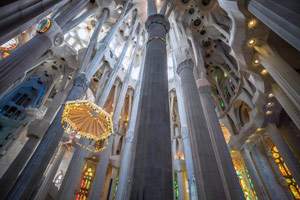
Gaudí designed two sacristies connected via the cloister that will surround the temple. This is the western sacristy and has one underground floor and five finished floors above ground with a glass dome. Visitors may enter the sacristy from inside the Basilica. The Liturgical Path takes visitors around the interior of the floor. Liturgical items designed by Antoni Gaudí are on display in the cloister and in the sacristy there are two wardrobes: one to store liturgical vestments worn by celebrants and priests and the other for various liturgical items, such as chalices and patens. The cupola has been a great step forward in construction of the Basilica.
The unique exterior construction will be the foundation for the temple's central towers.
Hearse
Wrought-iron hearse designed by Antoni Gaudí for the temple's crypt around 1898. Triangle-shaped candelabra formerly used for celebrating tenebrae, which corresponds to the prayers of the office of readings (matins) and laudes in the Paschal Triduum.
Two-branch candelabra
Wrought-iron candelabra designed by Antoni Gaudí for the temple's crypt around 1898. Used to celebrate mass, placed next to the altar.
Cross candelabra
Candelabra with two candlesticks topped with a Latin cross, designed by Antoni Gaudí for the temple's crypt around 1890, with two additional candlesticks Used to celebrate mass, placed on the altar.
Pulpit
Moveable wooden pulpit designed by Antoni Gaudí for the temple's crypt. Reproduction from approximately 1943 of the original from 1898. Formerly used by preachers to deliver their sermons to the congregation.
Missal stand
Tabletop missal stand for the crypt of the Sagrada Família Used to hold the missal, placed on the altar.
Candlestick
Two tabletop candlesticks for the crypt of the Sagrada Família designed around 1890. Placed on either end of the altar, in front, with candles lit during mass.
Altar cards
Chalk altar cards for Casa Batlló designed 1904-1906.
From the 16th or 17th centuries until the Second Vatican Council (1962-1965), three altar cards were placed on the altar to help the priest say mass. Only the middle altar card was obligatory, with the hymn Gloria in excelsis Deo, the Cannon and the Credo. The other two altar cards (introduced in the 17th century) contained the prologue to the Gospel according to St. John and the words Lavabo inter innocentes manus meas, respectively.
Source: Sagradafamilia.or
|
GOOGLE HONORS ANTONI GAUDÍ
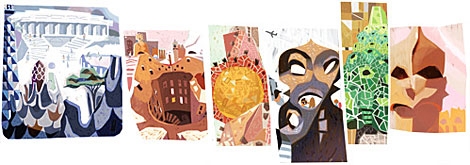
The Internet search engine Google dedicated its logo (“Doodle”) to the day Antoni Gaudí was born, June 26, to mark the 161 anniversary of his birth.
In commemoration of this fact, the six letters of Google were replaced by images of mosaics and architectural elements of GaudÃ's work such as one of the chimneys of La Pedrera, the emblematic building located at Passeig de Gracia in Barcelona.
By clicking on GaudÃÂ’s Doodle, we were able to go through some biographical articles about Antoni Gaudí such as Wikipedia and also images of his major works, photographs or portraits of the architect.
Antoni Gaudí, the famous Architect born in Reus (Tarragona) on June 26, 1852, is the highest representative of Catalan modernist architecture movement, with works such as the Basilica of the Sagrada Familia, Casa Calvet, Casa Batlló, Casa Milá, Park Güell, the Palau Güell, Casa Botines and the Episcopal Palace of Astorga (León), among others.
Thanks to Google, Gaudí is now even more universal even, if possible.
|
CENTENARY OF THE EPISCOPAL PALACE OF ASTORGA
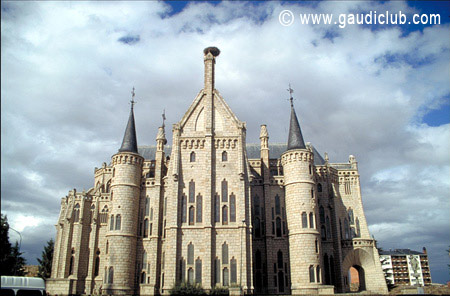
On the 25th of May of 2013, the Pope's Nuncio in Spain, Renzo Fratini, will inaugurate the events organized on the occasion of the centenary of the Episcopal Palace of Astorga, work of Antonio Gaudí and one of only three monuments that the Catalan architect designed outside of Catalonia.
Although exact details of the events for which Renzo Fratini will be present are yet to be unveiled, according to sources from the Dioceses of Astorga, it is anticipated that he will hold a mass that same day in the Cathedral.
In relation to the number of days that the Nuncio will visit the Catalan capital, these same sources confirmed that only his presence on the 25th is known with certainty, and that the following day Renzo Fratini will go to Ponferrada to meet the Dioceses.
The attendance of the Nuncio, who will be the main protagonist and greatest influence during the Centenary of the Episcopal Palace, is thanks to the personal invitation extended to him by the city's bishop, Camilo Lorenzo, following a visit to Madrid.
For this celebration, a commission has been set up consisting of the Bishopric of Astorga, the City Council, the University of León and the Chamber of Commerce, amongst others.
On the other hand, from the Dioceses of Astorga, it was clarified that the budget for this event is still not known, and therefore the programme of events involved in the centenary has not yet been made available.
|
THE GÜELL PARK IN DANGER
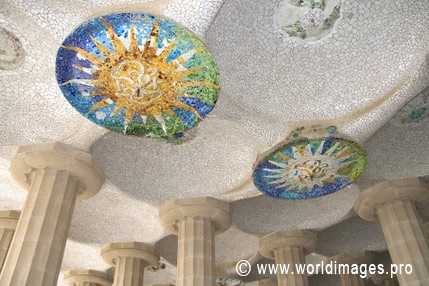
Mass tourism is damaging the Güell Park. Thousands of people enter here daily without any form of control.
The increased volume of visits is due to the Tourist Bus service, the principal means of transport by which tourists are transferred to this part of the city. Visitors continually disembark from the bus, and then move like a procession up the street that grants access to the park and they freely enter the grounds.
Then, the majority of them wander aimlessly about; some impatiently wait their turn to climb upon the lizard that greets them or take a photo in the main squareÂ’s viewing point. The most impudent even improvise football matches between the magnificent columns, using them as goalposts.
At the end of the tour, they buy the typical souvenir in one of the neighbourhoodÂ’s specialist shops with which to remember Gaudí'Â’s work and then they return to the Tourist Bus stop.
What a sad sight for one of the largest architectural works in Southern Europe, declared a World Heritage site by Unesco in 1994.
|
More Gaudí's
Works in the UNESCO
World Heritage
List !!!
|
Four properties built
by the architect Antoni Gaudí (1852–1926) in or near Barcelona
are added to his Parque Güell, Palacio Güell and Casa Mila in
Barcelona, inscribed on the World Heritage List in 1984. They testify
to Gaudí’s exceptional creative contribution to the development
of architecture and building technology in the late 19th and early 20th
centuries.
The four buildings added to the List are: Casa
Vicens (1883-85); Gaudí’s work on the Nativity façade
and Crypt of the Sagrada
Familia cathedral (1884-1926); Casa
Batlló(1904-06); Crypt
in Colonia Güell (1898-1905).
|
|
| GAUDÍ
TOURS |
 |
If you are planning
to visit Barcelona, let us prepare a tour for you. Take a guided
visit through all of the Gaudí works. Our guides are art
specialists. |
 |
"Barcelona
by Helicopter"
NEW!
Seize the occasion to enjoy the dream of flying in helicopter around
the city of Barcelona |
| GAUDINIST
GIFTS |
| Browse through our section
of special gifts inspired by designs of the master Antoni Gaudí.
 |
Jewelry
of design
The Modernism and the Contemporary Art inspire the design and the own style of each
one of these small works of art. |
|
|
|
|
|